
Is November a Good Time to Buy a House in San Antonio?

Is November a Good Time to Buy a House in San Antonio? (2026 Guide)
What if you could spend Christmas in your new home, negotiate a great deal, and potentially not make your first mortgage payment until February 2027?
Sounds pretty good, right?
Well, if you're thinking about buying a home in San Antonio, Texas, November might be a month worth paying attention to.
A lot of people assume they should put their home search on hold once the holidays roll around. Between Thanksgiving, Christmas shopping, traveling, and everything else going on, buying a house might be the last thing on their minds.
But here's what I've learned as a San Antonio REALTOR®: sometimes the opportunities other buyers overlook are the ones worth exploring.
Let's talk about what the San Antonio housing market looks like heading into November 2026, why buying before the holidays could make sense, and whether you should purchase now or wait until 2027.
What's Happening in the San Antonio Housing Market Right Now?
Before we talk about holiday shopping for houses, let's look at the actual market.
According to the Texas Real Estate Research Center at Texas A&M University, the San Antonio–New Braunfels housing market recorded the following in September 2026:
| Market indicator | September 2026 |
|---|---|
| Median home sale price | $303,000 |
| Months of housing inventory | 6.06 |
| Closed home sales | 2,727 |
Source: Texas Real Estate Research Center, San Antonio–New Braunfels metropolitan housing activity, September 2026.
So what does that mean for someone thinking about buying?
A market with approximately six months of inventory generally gives buyers more options than a market where homes are selling almost immediately.
That doesn't mean every seller is desperate or that every home is overpriced. It means there's a reason to examine individual properties, days on market, comparable sales, and opportunities to negotiate.
And when you combine those conditions with the holiday season, things can get interesting.
1. You Could Be in Your New Home Before Christmas
Let's start with one of my favorite reasons to buy in November.
Imagine waking up Christmas morning in your own home.
Your Christmas tree is up. Your family is gathered around. The kids are opening presents. And instead of thinking about another year of renting or waiting, you're making memories in a place that's yours.
That's a pretty special feeling.
If you begin looking in early November, get preapproved, find the right home, and go under contract, closing before Christmas may be possible.
Here's an example of how that timeline could look:
-
November 2–6: Speak with a lender, get preapproved, and begin touring homes.
-
November 7–13: Find the right property, negotiate, and go under contract.
-
Mid-November through December: Complete inspections, appraisal, underwriting, and other closing requirements.
-
Mid-to-late December: Close and move into your new home, assuming everything stays on schedule.
Of course, every transaction is different. Financing, appraisal timing, title work, inspections, seller circumstances, and holiday schedules can affect closing.
But if you're serious about buying, starting early in November gives you a realistic opportunity to explore a Christmas move-in.
2. Close in December, and Your First Mortgage Payment Could Be Due February 1, 2027
Here's something that surprises a lot of first-time homebuyers.
When you buy a home with a typical mortgage, your first regular payment usually isn't due the following month.
For example:
If you close on December 18, 2026, your first mortgage payment would typically be due February 1, 2027.
That's right.
You could potentially move into your new home before Christmas and not have your first regular mortgage payment due until February.
Why?
Mortgage interest is generally paid in arrears, and buyers typically prepay the interest from their closing date through the end of that month as part of their closing costs.
So you're not getting free months or avoiding interest. It's simply how the normal mortgage payment schedule works.
And this can be helpful when you're planning for moving expenses, furniture, holiday spending, and your household budget.
Important: Your lender will confirm the actual first payment date in your closing documents. Don't assume a payment date until it's verified.
3. There May Be Fewer Buyers Competing With You
Think about what most people are doing in November and December.
They're traveling, shopping for the holidays, hosting family, and planning for the new year.
Some buyers put their home searches on pause.
That can mean less competition for certain homes.
And when there are fewer competing offers, you may have more room to negotiate.
You might be able to ask for a price adjustment, seller-paid closing costs, repairs, or other concessions that make financial sense.
But there's a tradeoff: Some sellers also take their homes off the market during the holidays, which can reduce your options.
That's why I wouldn't tell anyone that November automatically guarantees a better deal.
The opportunity depends on the home, the seller, the price range, and the local competition.
My job is to help you understand those details before making an offer.
4. San Antonio Homebuilders May Have Incentives Worth Exploring
If you've followed my real estate content, you've probably heard me talk about new construction incentives.
And there's a reason for that.
When builders have available inventory, particularly homes they want to close before year-end, they may offer incentives to attract qualified buyers.
Depending on the builder, community, home, lender, and current promotion, those incentives could include:
-
Interest rate buydowns
-
Contributions toward closing costs
-
Price reductions
-
Included appliances or blinds
-
Other upgrades or financing incentives
I've helped buyers negotiate substantial concessions, and I've seen how much the overall package can matter.
But here's something I always want buyers to understand:
The biggest advertised incentive isn't automatically the best deal.
A lower interest rate might sound incredible, but we need to compare the home's price, loan terms, closing costs, taxes, insurance, and long-term payment.
We also need to understand whether the rate is temporary or fixed for the life of the loan.
Sometimes a resale home with a lower purchase price is the better value. Other times, a builder's financing package makes new construction especially attractive.
That's why we compare both.
5. Sellers Who Are Still Listed During the Holidays May Have a Reason to Move
Not everyone selling a home in November has the luxury of waiting until spring.
Some homeowners are relocating for work. Others are moving because of family circumstances, financial decisions, or an upcoming purchase.
And here in Military City USA, military relocations can happen throughout the year.
A home that's been sitting on the market may deserve a closer look, especially if the seller is motivated to close before the end of December.
Does that mean you should automatically submit a lowball offer?
Absolutely not.
It means we research the property, study comparable sales, review its listing history, and build an offer based on evidence.
A well-structured offer can sometimes accomplish more than simply asking for the biggest price reduction.
6. Should You Buy a New Construction Home or a Resale Home?
This is one of the biggest questions I get from San Antonio buyers.
And the answer depends on what matters most to you.
New construction could make sense if:
You want modern layouts, newer systems, builder warranties, and the possibility of financing incentives.
Communities across the Far West Side, Converse, Schertz, Cibolo, and other growing areas may offer different new-home options.
Resale could make sense if:
You want an established neighborhood, mature trees, a particular location, or a home with features that might cost extra in new construction.
Areas such as Alamo Ranch, Stone Oak, Bulverde, Boerne, and neighborhoods throughout San Antonio offer a wide variety of existing homes.
Neither option is universally better.
We need to compare what you're actually getting for your money, including property taxes, HOA fees, maintenance, commute, and monthly payment.
7. Should You Buy in November 2026 or Wait Until 2027?
Now for the big question.
What if interest rates drop next year?
What if prices go down?
What if there are better incentives in the spring?
Those are fair questions.
But here's the thing: Nobody can promise you exactly what mortgage rates or home prices will do in 2027.
If rates fall, more buyers could enter the market. If inventory increases, you might have more choices. If prices shift, the impact could be very different depending on the neighborhood.
Instead of trying to predict the future, I'd rather help you answer a few questions about your own situation.
Can you comfortably afford the payment today?
Do you have enough money for your down payment, closing costs, and reserves?
Are you planning to stay in the home long enough for buying to make sense?
Does the property meet your needs?
And are there current opportunities that make the purchase worthwhile?
If the numbers work and the home fits your plans, buying now could make sense.
If they don't, waiting may be the smarter decision.
A good deal isn't a good deal if it puts you in a difficult financial position.
8. What About VA Loans, FHA Loans, and First-Time Buyers?
San Antonio is home to a large military and veteran community, but there are financing options for buyers from all backgrounds.
If you're eligible for a VA loan, you may be able to purchase with no down payment, subject to entitlement, lender requirements, and the terms of the loan.
FHA financing can also provide a path to homeownership for eligible buyers who need a lower down payment.
And conventional loans aren't exclusively for buyers putting 20% down. Some programs offer much smaller down payment requirements.
The key is talking with a qualified lender before you begin shopping.
That way, we can focus on homes and financing strategies that actually fit your situation.
And if you're PCSing to Joint Base San Antonio, whether that's Lackland AFB, Fort Sam Houston, or Randolph AFB, we can also factor in your reporting date, commute, housing allowance, and long-term plans.
9. Where Should You Look for a Home in San Antonio?
San Antonio isn't a one-size-fits-all market.
A buyer searching near Lackland AFB may have completely different priorities from someone wanting a little more space in the Texas Hill Country.
Here are several areas worth researching depending on your needs:
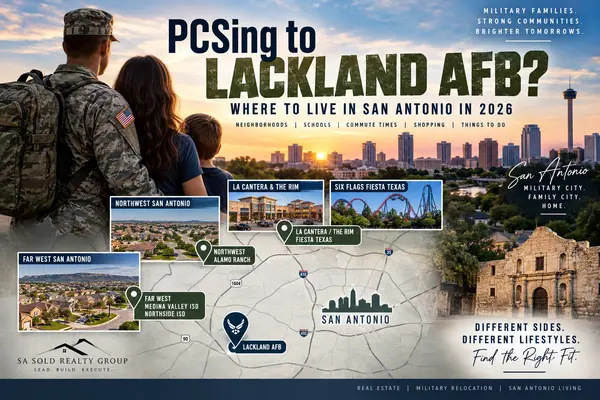
Far West San Antonio and Alamo Ranch: Options ranging from established neighborhoods to newer communities, with access to major shopping and West Side amenities.
Converse, Schertz, and Cibolo: A variety of resale and new-construction communities, with locations that may appeal to buyers commuting toward Randolph AFB or other Northeast Side destinations.
Bulverde and Boerne: Hill Country settings, different lot sizes, and communities for buyers looking beyond central San Antonio.
Stone Oak and North San Antonio: Established residential areas with access to shopping, restaurants, and major roadways.
Central San Antonio: A mix of historic properties, established neighborhoods, and urban living options.
Before choosing a home, research the actual commute, property taxes, insurance, neighborhood restrictions, and school attendance boundaries if relevant to your household.
For public school information, buyers can use the Texas Education Agency's official resource at TXschools.gov and verify attendance zones directly with the district.
The right neighborhood is the one that works for your lifestyle and budget.
10. What Would I Negotiate If You Were Buying a Home This November?
This is where having an experienced agent in your corner matters.
I'm not just looking at the asking price.
I'm looking at the full transaction.
Depending on the home and the circumstances, I may evaluate opportunities involving:
Purchase price: Is the home priced appropriately compared with recent sales?
Seller concessions: Could the seller contribute toward allowable closing costs or financing expenses?
Interest rate incentives: Is a temporary or permanent buydown available, and does it make financial sense?
Repairs: What does the inspection reveal, and what should be addressed before closing?
Included items: Are appliances, blinds, or other items negotiable?
Closing timeline: Could the seller accommodate a December closing?
Every situation is different, and concessions are subject to the loan program and lender requirements.
But the objective stays the same: Help you purchase the right home with terms that make sense for you.
Frequently Asked Questions About Buying a House in San Antonio in November
Is November a good month to buy a house in San Antonio?
It can be. Some buyers pause their searches during the holidays, potentially reducing competition. But available inventory, seller motivation, and negotiating opportunities vary by property and neighborhood.
Can I buy a home in November and move in before Christmas?
Yes, it's possible, especially if you're preapproved and find a home early in November. Closing timelines vary, and no move-in date should be guaranteed until the lender, title company, and other parties confirm it.
If I close on a house in December 2026, when is my first mortgage payment?
For a typical mortgage, your first regular payment would usually be due February 1, 2027. Your lender will confirm the exact date in your closing documents.
Are San Antonio homebuilders offering incentives in late 2026?
Some builders may offer rate buydowns, closing-cost assistance, price reductions, or other incentives on eligible homes. Promotions vary and should be confirmed directly before making a purchasing decision.
Should I wait until 2027 to buy a home in San Antonio?
That depends on your finances, housing needs, and the opportunities available now. Waiting may be appropriate for some buyers, while others may find a home and payment that work for them today. Future rates and prices are uncertain.
Can I use a VA loan to buy a home before Christmas?
Yes, eligible buyers can use VA financing for a home purchase, including during the holiday season. The timeline depends on underwriting, appraisal, property eligibility, and other closing requirements.
The Bottom Line: Don't Overlook November
Buying a home during the holidays might not be the first thing on your mind.
But when you consider the possibility of less competition, negotiating opportunities, builder incentives, and potentially moving in before Christmas, it's worth having the conversation.
And if you close in December, your first regular mortgage payment could potentially be due in February 2027.
I'm not here to tell you everyone should buy a house right now.
I'm here to help you understand your options, look at the numbers, and make a decision that makes sense for your family.
Before you decide to wait until 2027, let's see what your budget could get you in San Antonio today.
Whether you're buying your first home, relocating to Military City USA, moving into the Texas Hill Country, or simply ready for your next chapter, I'd love to help.
James Green, REALTOR®
SA SOLD Realty Group | REAL Broker
San Antonio, Texas & the Texas Hill Country
Your Move. Your Mission. Let's Execute.
Market data reflects the latest verified September 2026 figures available when this article was prepared. Housing conditions, mortgage rates, and builder incentives can change. Consult your lender for financing terms and payment dates.
Sources and helpful resources
Categories
- All Blogs (8)
- buying vs renting (1)
- First Time Home-Buyers (5)
- Home Buying Tips (1)
- Local Events (1)
- Military Relocation (3)
- Moving To San Antonio (4)
- New Construction (1)
- PCS Guides (2)
- San Antonio Housing Market (1)
- San Antonio Lifestyle (1)
- San Antonio Real Estate (4)
- Things to Do in San Antonio (1)
- VA Home Buyers (2)
- VA Home Loan (4)
Recent Posts






"My job is to find and attract mastery-based agents to the office, protect the culture, and make sure everyone is happy! "